Regrets? Frank McKenna has a few, but this former premier just accomplished something astonishing
By Steve Paikin
Steve Paikin is a contributing columnist at the Star and the former host of TVO’s “The Agenda.”
Steve Paikin: Can we start by having you compare how Canada’s doing under Donald Trump versus under George W. Bush, when you were our ambassador down there? Frank McKenna: I was in Washington just after we made the decision not to go into the Iraq War with them, which was one of the great unforced errors of our times — the United States invading Iraq. This current crowd down there would be apoplectic about it. But Bush was very cool and calm. He said, “Frank, I respect your prime minister and your sovereign country. You have the right to make the decision that you made.” And I just thought that was wonderful. What would you be doing if you were our ambassador there today? It’s very difficult because Trump has such a narcissistic personality. People would say that he’s got malignant narcissism. And I think that that is almost diagnosable. He needs constant attention. He’ll say the most negative things just to get attention, attacking countries, attacking personalities. Somebody dies and he demonizes them before they’re even buried. I mean, these are not normal things. It’s also not normal for a former diplomat to be speaking so undiplomatically. Yeah, I was never a very good diplomat. But it’s so hard to remain calm and keep your cool when such provocative language is used. Trump says “Your country contributes nothing; you have nothing we need; we’re going to make you the 51 state; Chrystia Freeland is a terrible woman; your former prime minister was a weakling.” This is not normal behaviour, trashing other leaders and trashing the memory of people. So I think we’re doing the right things. Keep calm. Carry on. Be respectful. Don’t rise to the provocation. The problem is that the President sets the tone, but everybody’s trying to suck up to him. If you had five minutes with him alone in a room, what would you tell him? What I would tell him is that we are not the enemy, and that we contribute as much or more than we take from the relationship, and that we are all stronger working together, and that he would be smart to sit down with us and work respectfully on defence issues, on critical minerals, on energy security. The Americans do give us market access. But we provide 4 million barrels of oil a day, which they transform into jobs. We provide 70 per cent of their aluminum, which they turn into jobs. We provide their potash, 85 per cent of it, which they turn into crops and jobs. Thirty-six per cent of their tourism comes from Canadians going to America. We’re givers and contributors in this relationship. And that’s what I would want to remind him. Do you think markets act as democratic guardrails against some of his worst impulses? I think so, and unfortunately a lot of guardrails have been destroyed. The Supreme Court has become a partisan court. All the regulatory agencies have now become highly partisan. There was a very active attempt to make the Federal Reserve partisan. And that’s not healthy in a
democracy. You’ll notice a few weeks ago, there was a vote in Congress where a number of Republicans crossed the floor and joined Democrats
voting for a resolution saying there should not be tariffs on Canada. We do
have friends down there. Janice Stein from the University of Toronto has said that she thinks the world is a more dangerous place today than it was at the height of the Cold War. What do you think? I agree with her. There’s so much volatility and so much chaos. We always had for seven or eight decades what we called Pax Americana, where the United States was a force for good in the world, and helped to solve problems and bring people together. The United States led in the construction of most of the multilateral instruments in the world and it’s now spearheading the effort to demolish them all. The policeman of the world has gone rogue. I do want to ask you about your relationship with former prime minister Brian Mulroney, since both of your names are on various buildings at St. Francis Xavier University. When you got elected as the premier in 1987, he was in the midst of trying to put together the Meech Lake Constitutional Accord, and if memory serves, you were the first premier to criticize that effort and to say, ‘I’m not sure about this.’ True or false? True. I had all kinds of people saying, we need to improve the protection for Canadians in all sorts of ways. But it was the biggest mistake of my life. Brian Mulroney deserved to have Meech Lake implemented and by taking time, I permitted others to enter the debate, who ended up being much more critical. I allowed (Newfoundland premier) Clyde Wells to come in and destroy the Accord and take away from Brian Mulroney what would have been his greatest achievement. So that’s been a regret of mine all my life. And yet, Brian Mulroney never demonstrated to me the slightest bit of malice about that. In fact, the first day that I went to a First Ministers Meeting as premier, he made a point of walking down from the chairman’s chair, and walked up to me, threw his arm around me and put his (St. FX) ring down next to mine, and said, “We’re just going to get along great!” And he was like that the entire time I was in public life. I’d like to tell any premier, if somebody has taken the hill at great cost, don’t screw it up. And that was the mistake I made. I’ve spent the rest of my life trying to atone for that mistake. There was a moment about 20 years ago when you thought hard about running for the federal Liberal leadership and had you won, you would have become prime minister. But you opted not to. Any regrets about that all these years later? I have no regrets about that. I was lucky enough three or four times to get close to the altar. In fact, Brian encouraged me a number of times. And Prime Minister (Jean) Chrétien too. But I had 16 years of public life, and that’s 16 years where you’re not the best husband, not the best father that you should be. And I wanted a chance to reclaim some of those years, and have really wonderful years with my grandchildren. And, so I was able to get out of public life with, I think, my honour intact. As we say in the firm, once you escape the trap, don’t go back for the cheese. OK, but how about as premier of New Brunswick. You were there for 10 years. What didn’t you get done that you wish you had? It’s a very good question and you could you can drive yourself crazy reflecting on what more you should have done. I pretty well blew out the gas tank, but I probably would have wanted to tackle universities, to bring some daylight into the governance of them. They’re such a force for good in so many ways. But in a world now that’s going at warp speed, I think universities have to move faster and be more responsive to the societies in which they exist. Speaking of universities, since you announced your contribution to St. FX, I’ve been asked many times: how does Frank McKenna have $20 million to give away? What’s the answer? Well, the answer is that I don’t, but my kids do! Look, I’m the luckiest guy in the world. I just vowed that any time I could give back, I was going to give back. I would make money, and we didn’t need money because we would live very modestly. So everything that I made, stayed in the bank. And so I am here today as the poster child of the miracle of compounding (interest). And we’re going to be doing lots more things, giving back, until the day we die.
Few Canadians have had a more fascinating career than Frank McKenna. His life started in poverty 78 years ago in New Brunswick as one of eight kids — so many that the family was too big for one home; McKenna went to live with his grandparents. Eventually, he became premier of New Brunswick (winning every seat in the 1987 election), Canada’s ambassador to the U.S. when George W. Bush was president, then moving to Toronto where, for the last 20 years, he’s been deputy chair of the TD Bank. Earlier this month, McKenna announced he’d donate an astonishing $20 million to his alma mater, St. Francis Xavier University in Nova Scotia.
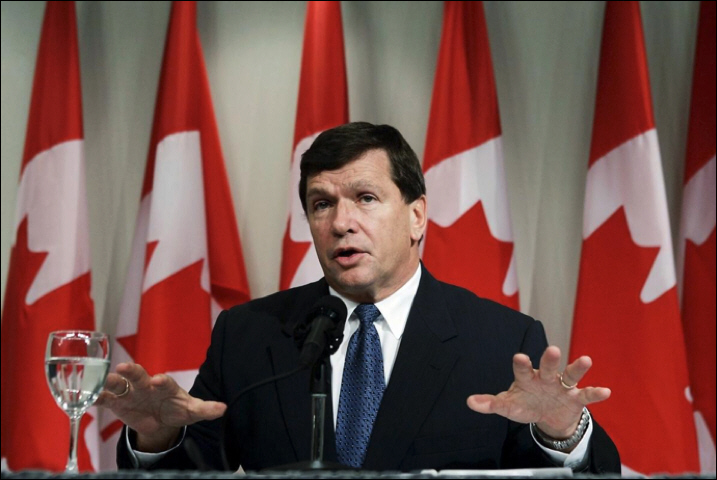
Frank McKenna is seen in January 2006, when he was Canadian Ambassador to the United States EVAN VUCCI AP